top of page

Work Smarter, Not Harder: Rethinking Performance with Dr. Elina Haukipuro

  • 18 hours ago
  • 5 min read

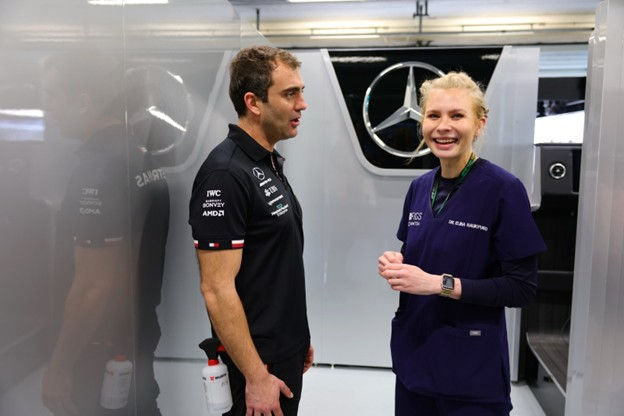
I recently sat down with Dr. Elina Haukipuro, and honestly, her perspective was refreshing. She’s not just another performance coach. She’s a physician and elite performance specialist who has worked at the very top of motorsport, including Formula 1 teams like Mercedes AMG Petronas and Williams Racing.


Her background crosses sports medicine, psychology, and mental coaching, with certifications tied to high performance environments like the International Olympic Committee. Her thinking is super integrated. She doesn’t treat physical performance, and mental resilience as separate conversations, but a unified system.


The big idea I can’t stop thinking about.


Early in the conversation, she said something that to me completely reframes how we think about mastery at an elite level. She said, “Performance is not the thing you build, but what happens when the underlying foundation is strong.”


I stopped at that one for a minute. Because in business, we’re obsessed with results and outputs. Revenue, growth, productivity and more. But what she’s saying is almost the opposite. We usually chase performance outputs full frontal. But her point was getting the foundation right first, and performance naturally tends to follow.


She broke this foundation down simply into stable physiology, strong mental health and recovery treated as part of work, not some kind of separate reward. To me that last one is where most organizations fall apart and therefore, I wanted to know more.


Recovery is not a reward, but it’s part of a complete performance system.


Elina went on to say, “Recovery shouldn’t be something you earn after finishing something significant, but something that happens all the time.” I’ve found that this challenges how most of us operate. We grind, push, and then collapse at the end of the day or week. But Elina is saying that doesn’t work biologically. “Very few of us can do 8 hours of focused work. Maybe 3 to 5 hours at most.”


To be honest I don’t think enough leaders fully appreciate this. Because if that’s true, then a lot of what we call productivity is just wasted work. What reinforced this insight for me was research from Priority Management showing that deliberate rest is not lost time. Strategic breaks and quiet time restore cognitive energy and help reset the prefrontal cortex, which improves clarity, focus, and problem-solving.


For business leaders, the message is straightforward: recovery is not separate from performance. It is part of it. Furthermore, according to the National Sleep Foundation, sleep is an economic asset, not a luxury. Adequate rest is scientifically linked to sharper decision-making, stronger emotional intelligence, and sustained cognitive stamina. In other words, sacrificing sleep often produces diminishing returns.


To me, this has a direct business implication. If recovery isn’t designed into the system, performance eventually drops. And often you don’t notice it until it’s too late.


What “Race Ready” really looks like.


Another part I was struck by was how she defines readiness. Not just in obvious ways, but in what she called the “non-obvious signals.” We tend to think readiness equals preparation. But I found her perspective is way more nuanced.


With her Formula 1 drivers she looks at things like sleep quality, energy perception, irritability, focus and external stressors, including relationships using data analytics. Elina explains how “You can’t treat mental and physical performance separately, at least not sustainably.” 


That is also why tools that track health and readiness are becoming more relevant in business. According to JLL, everything from smart watches to helmets and goggles are playing a growing role in helping employees stay healthier and perform better at work. In other words, performance is increasingly being supported by data on human capacity, not just results.


Where confidence really starts to slip.


I found her story about confidence also a vital one, because it’s something leaders deal with all the time, but rarely talk about. She described how confidence doesn’t collapse suddenly, but “It erodes quietly and slowly over time.”


That felt very real. 


One bad outcome leads to pressure. Pressure leads to overthinking. Overthinking leads to hesitation. And suddenly performance drops again.


What this really means is her solution wasn’t “try harder.” It was the opposite. She emphasized maintaining recovery even under pressure, protecting non work identity and personal life and reducing exposure to negative external noise like social media.


This seems counterintuitive. Because most leaders respond to failure by doubling down. But she’s saying that’s exactly what makes the spiral worse.


Mental agility is a trainable skill.


We then got into how elite Formula 1 drivers stay composed while making split second decisions at extreme speeds. The practical point here is simple. She talked about attentional control, breathing techniques, scenario planning and positive self-talk. Self-talk is something Olympic gold medal winner Chandra Crawford lives by, because she said it shapes your internal dialogue and can become a powerful tool to regulate emotions, build confidence, and maintain focus under pressure.


In business, self-talk directly affects resilience, decision-making clarity, and how effectively people navigate high-stakes situations. Research highlighted by the Center for Creative Leadership explains how in business constructive self-talk is positively associated with increased creativity and leadership skill, while also reducing job strain.


Elina adds that, “These are not personality traits. They are skills that anyone can train.” These skills have big implications for leaders, especially in uncertain environments where adaptability is everything. I’ve found that scenario thinking, which is something I’ve researched extensively during my Doctorate, is massively underused in business, even though it builds strategic flexibility.


So, what does this all mean for business leaders?


If I step back, there are a few very actionable nuggets to me business leaders can apply immediately:


  • Prioritize recovery: Treat recovery as part of work, not something outside of it.

  • Manage capacity: Redesign workdays around actual human cognitive capacity, not assumed capacity.

  • Watch for wellbeing: Build systems that monitor wellbeing signals, not just output or results metrics.

  • Train your mental agility: Train mental skills like focus, self talk, and scenario planning intentionally.

  • Maintain balance: Normalize saying “not now” to protect performance, not reduce ambition.

  • Monitor confidence levels: Watch for slow confidence erosion and intervene early.


Final thought: The foundation is the strategy.


If there was one idea I took away from the conversation, it was this: performance is usually the result, not the starting point. In business, we often focus on output and assume the foundation will somehow take care of itself. But it rarely does. Most businesses are operating in permanent sprint mode, chasing results, while slowly eroding the very foundation that enables those results.


What Dr. Elina Haukipuro made clear is that resilience isn’t about enduring more. It’s about recovering faster.  This is a completely different way to think about elite performance. In a world of constant pressure, uncertainty, and change, the real advantage isn’t working harder. It’s building systems that allow people to perform consistently without breaking. It’s working smarter. Because in the end, performance doesn’t come from pushing people. It comes from giving them a foundation strong enough to bounce back, adapt, and keep going when it matters most.


Dr. Lance Mortlock is the author of Outside In, Inside Out – Unleashing the Power of Business Strategy in Times of Market Uncertainty, EY Canada Managing Partner, Industrials & Energy, Strategist & Adjunct Associate Professor.

Comments


freepik_br_4bdd58d4-73ff-4138-8470-13447e08cbbd 1 (2)_edited.png

Dr. Lance Mortlock

DR. LANCE MORTLOCK is the Managing Partner, Energy & Resources Canada at Ernst & Young (EY) and has provided management consulting services on 200+ projects to more than 80 clients in 11 countries.

Recent POSTS

bottom of page